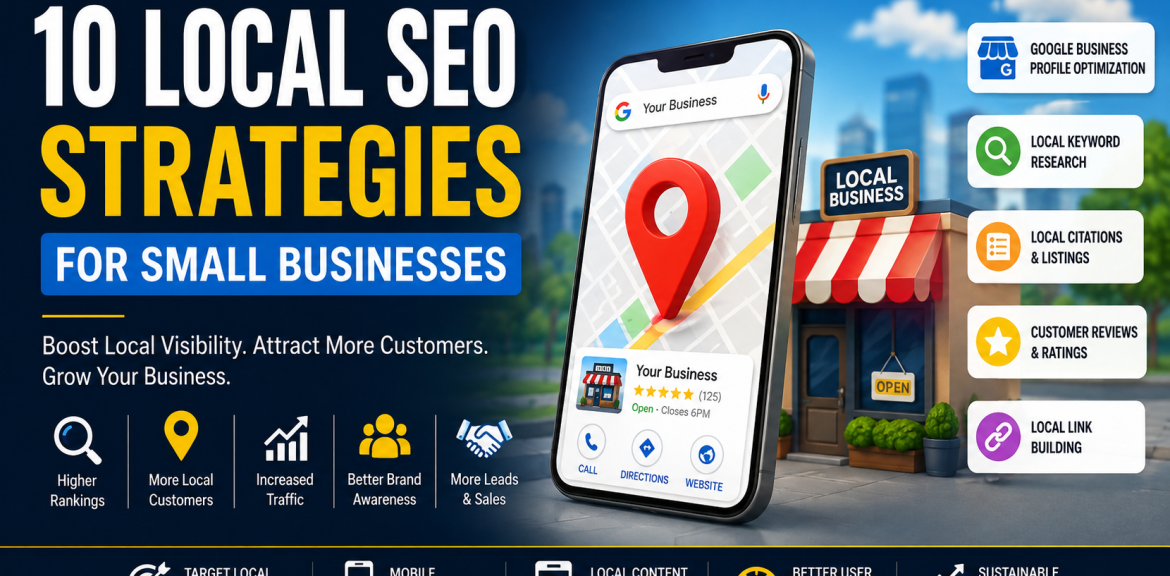

For small businesses, local SEO provides a practical way to become more visible when nearby customers search for products or services. Whether we operate a restaurant, law firm, dental practice, property company, trades business, retail store, marketing agency, or professional service, appearing prominently for searches with local intent can put our business directly in front of people who are ready to take action.
Local search visibility is particularly valuable because customers often search with specific needs such as “plumber near me,” “best accountant in Leeds,” “coffee shop near me,” or “property management company in Manchester.” These searches indicate strong commercial intent. By building a structured local SEO strategy, we can improve our visibility across Google Search, Google Maps, and other important local discovery platforms.
Below are 10 proven local SEO strategies for small businesses that we can implement to build stronger local visibility, attract qualified visitors, and generate more enquiries.
1. Optimise Our Google Business Profile
A fully optimised Google Business Profile (GBP) should be the foundation of our local SEO strategy. It gives Google and potential customers essential information about our business, including our name, address, phone number, website, services, opening hours, photos, reviews, and business category.
We should ensure every section is complete and accurate. Our primary business category should describe the core service we provide, while secondary categories can represent additional services where appropriate.
We should also maintain consistency between our Google Business Profile and our website. The business name, contact information, operating hours, service details, and location information should not contradict one another.
Regular activity can also strengthen the usefulness of the profile for customers. We can publish relevant updates, add new photographs, highlight services, answer questions, and keep information current whenever our business changes.
Most importantly, we should avoid stuffing keywords into the business name or adding inaccurate information simply to manipulate local rankings. Our profile should accurately represent the real-world business.
2. Build Location-Focused Website Pages
A local business website should make it immediately clear where we operate and what services we provide.
Instead of relying on a single generic service page, we can create useful location-specific pages when we genuinely serve those areas. For example, a property management company serving multiple cities could create pages targeting relevant combinations such as:
- Property Management in Leeds
- Property Management in Bradford
- Property Management in Manchester
- Student Accommodation in Leeds
- HMO Management in Leeds
Each location page should provide genuinely useful information rather than simply replacing the city name throughout an identical template.
We can include local service details, areas covered, customer concerns, relevant regulations, examples of work, frequently asked questions, and clear contact options. This gives search engines stronger contextual information while creating a better experience for prospective customers.
3. Conduct Local Keyword Research
Effective local SEO starts with understanding how customers actually search.
We should identify keywords combining our products or services with relevant locations, neighborhoods, and local intent. Depending on the business, these may include terms such as:
- “letting agent Leeds”
- “property management Leeds”
- “SEO agency Bradford”
- “accountant near me”
- “emergency plumber Manchester”
- “wedding catering Leeds”
- “dentist in Huddersfield”
We should also consider longer, more specific searches. A customer searching for “student accommodation Leeds bills included” has a more defined requirement than someone searching simply for “Leeds accommodation.”
Our keyword strategy should therefore cover different stages of the customer journey, including informational searches, service searches, location searches, and high-intent commercial queries.
We should map each important keyword group to the most relevant page instead of attempting to rank one page for every local search.
4. Keep Business Information Consistent Everywhere
Consistency in our name, address, and phone number (NAP) remains an important component of local visibility.
We should review business information across:
- Google Business Profile
- Website
- Bing Places
- Apple Maps
- Local directories
- Industry directories
- Social media profiles
- Chamber of commerce listings
- Relevant professional associations
If our business moves, changes telephone numbers, or updates its official name, we should update important listings rather than allowing outdated information to remain online.
Inconsistent information can create confusion for customers and make it harder for search engines to confidently connect different online references to the same business.
We should also use a consistent business format across important profiles, particularly for the official business name, address, and telephone number.
5. Earn High-Quality Local Citations and Links
Local citations are online references to our business, while local backlinks are links from other websites to our site.
We should focus on quality rather than collecting hundreds of irrelevant directory listings. Relevant local and industry websites can provide considerably more value than low-quality directories created solely for links.
Potential opportunities include:
- Local business directories
- Industry associations
- Local newspapers
- Community organisations
- Business networking groups
- Local chambers of commerce
- Universities and educational organisations
- Sponsorship pages
- Local event websites
- Relevant suppliers and business partners
We can also create useful local resources that naturally attract links. For example, a property company might publish a guide to renting in a particular city, while a catering company could create a detailed guide to planning events locally.
The strongest local link opportunities are usually those that make sense from a real business or community perspective.
6. Build a Consistent Review Strategy
Online reviews can significantly influence whether potential customers choose our business. They also provide valuable signals about customer experiences and the services we offer.
We should establish a simple and consistent process for requesting reviews from genuine customers.
After completing a successful service, we can send customers a direct review request through an appropriate channel. The process should be convenient and should direct customers to the relevant review platform.
We should never manufacture reviews or pressure customers into providing misleading feedback.
Our responses to reviews matter as well. We should respond professionally to positive reviews and address negative reviews constructively. Where a customer raises a legitimate issue, our response should demonstrate that we take the concern seriously.
Reviews can also naturally contain descriptions of our products, services, and customer experiences, making them valuable sources of authentic language that prospective customers can understand.
7. Create Locally Relevant Content
Local businesses have an advantage that national websites often cannot easily replicate: first-hand local knowledge.
We can use that knowledge to produce content that genuinely helps people in the areas we serve.
For example, a property business could publish:
- A guide to renting property in Leeds
- HMO regulations landlords should understand
- Best areas for students in Leeds
- A landlord’s guide to property maintenance
- Common rental mistakes new landlords make
A catering business could create:
- Event catering ideas for local venues
- Corporate catering guides
- Wedding catering planning tips
- Seasonal menus
- Local event catering checklists
The key is to avoid producing dozens of thin pages that provide little useful information. Instead, we should develop comprehensive resources addressing real questions from local customers.
This content can also support our service pages through strategic internal linking.
8. Optimise for “Near Me” and Mobile Searches
A significant portion of local discovery happens on smartphones. Customers may search while travelling, shopping, comparing businesses, or looking for immediate assistance.
Our website should therefore provide a strong mobile experience.
We should make essential information easy to find, including:
- Phone number
- Address
- Opening hours
- Directions
- Services
- Pricing information where appropriate
- Booking or enquiry options
- Contact forms
Clickable telephone numbers can make it easier for mobile users to contact us. Clear calls to action should appear naturally throughout important pages.
We should also ensure our website loads efficiently and that visitors can navigate it without excessive scrolling, intrusive elements, or difficult-to-use forms.
For businesses serving customers at a physical location, accurate location information and map details are particularly important.
9. Strengthen On-Page Local SEO
Every important local landing page should clearly communicate its purpose.
We should optimise relevant elements such as:
- Page title
- Meta description
- H1 heading
- Subheadings
- Body content
- Image alt text where appropriate
- Internal links
- URL structure
- Contact information
For example, instead of using a generic title such as “Our Services,” a business could use a more descriptive title such as “Property Management Services in Leeds | Professional Landlord Support.”
We should naturally incorporate location and service terminology without forcing keywords into every sentence.
Internal links are equally important. A local service page can link to relevant service categories, supporting guides, contact pages, and related location pages. This helps visitors discover additional information while creating a clear website structure.
10. Track Local SEO Performance and Improve Continuously
Local SEO should be treated as an ongoing business process rather than a one-time setup.
We should regularly monitor important indicators such as:
- Local search visibility
- Google Business Profile interactions
- Website enquiries
- Phone calls
- Direction requests
- Website traffic from local searches
- Keyword positions
- Review volume and sentiment
- Organic conversions
- Performance of location pages
Rather than focusing only on rankings, we should connect local SEO activity to meaningful business outcomes.
For example, if a page receives substantial traffic but generates very few enquiries, we should examine its content, calls to action, trust signals, service information, and user experience.
If one location page consistently produces leads while another receives little engagement, we can investigate differences in search demand, competition, content quality, local relevance, and conversion opportunities.
How We Can Combine These Local SEO Strategies
The strongest results usually come from combining these strategies rather than treating them as isolated tasks.
We can begin by establishing an accurate Google Business Profile, researching local keywords, and ensuring our business information is consistent across important platforms. We can then strengthen our website with useful service and location pages, build genuine local relationships, collect customer reviews, and publish authoritative local content.
Once these foundations are established, we can continually improve based on real performance data.
For example, if customers frequently search for a service in a particular neighborhood, we can create a dedicated resource addressing that demand. If customers repeatedly ask the same question, we can turn the answer into a detailed FAQ or guide. If a local publication covers our industry, we can look for legitimate opportunities to contribute useful expertise.
This approach creates a local SEO system that becomes more valuable over time.
Local SEO Checklist for Small Businesses
We can use the following checklist to keep our local SEO work organised:
- Optimise and verify our Google Business Profile
- Select accurate primary and secondary business categories
- Keep business information consistent across the web
- Research local and service-based keywords
- Optimise titles, headings, URLs, and page content
- Create genuinely useful location pages
- Publish locally relevant educational content
- Build relationships with relevant local organisations
- Earn authoritative local backlinks
- Encourage genuine customer reviews
- Respond professionally to reviews
- Optimise the website for mobile visitors
- Make contact information easy to find
- Improve internal linking between relevant pages
- Monitor local traffic, calls, enquiries, and conversions
- Update outdated business and location information regularly
Final Thoughts on Local SEO for Small Businesses
A successful local SEO strategy for small businesses is built around relevance, accuracy, usefulness, and genuine local presence. We do not need to compete with national companies on every possible keyword. Instead, we can concentrate on the locations, services, and customer needs that are most valuable to our business.
By combining an optimised Google Business Profile with strong location pages, accurate business listings, targeted local keywords, genuine reviews, relevant backlinks, useful content, mobile optimisation, and continuous performance tracking, we can build a stronger presence where local customers are actively searching.
The objective is simple: make it easy for the right customers to discover us, understand what we offer, trust our business, and take the next step.